
Organic corn starch powder has become a dependable clean-label input for manufacturers across categories in Canada—from nutraceuticals and dietary supplements to bakery, functional foods, beverages, personal care, and pet nutrition. As sourcing teams and R&D functions collaborate more closely on ingredient qualification, three factors consistently determine whether a batch meets industrial requirements: moisture, particle size, and functional behavior.
For buyers evaluating Bulk Organic Corn Starch Powder, these characteristics shape performance, processing efficiency, consistency, and regulatory alignment.
This guide outlines how procurement teams, formulators, and quality units can examine these parameters when working with bulk suppliers in Canada or comparing wholesale price options.

What Does Moisture Tell Buyers About Quality and Processing Conditions?
Moisture levels indicate shelf stability, processing consistency, and suitability for applications that require precise flow and hydration behavior.
Moisture is one of the first parameters procurement managers check when assessing Bulk Organic Corn Starch Powder. Starch’s ability to maintain flowability, stability, and predictable behavior depends heavily on controlled moisture levels.
Why moisture matters in bulk procurement
– Shelf stability: High moisture increases susceptibility to clumping during storage and transit, impacting flow and dosing during production.
– Thermal stability: Excess moisture can affect gelatinization behavior during heat application, causing inconsistent thickening or binding performance.
– Microbial safety: Lower moisture reduces the likelihood of microbial growth, an essential requirement in many food and supplement production environments.
Typical moisture ranges
Organic corn starch powder generally falls within a 10–14% moisture range under normal industry standards. Buyers should expect specifications clearly stating:
– Moisture percentage
– Method used for testing
– Acceptable deviation limits
When sourcing from Bulk Organic Corn Starch Powder suppliers, confirm that each batch includes moisture validation in the Certificate of Analysis (COA) and that values are aligned with expected application needs.
Considerations for Canadian buyers
Since environmental humidity varies across provinces, especially during shipping from international origins, Canadian manufacturers should verify:
– Container moisture control practices
– Use of food-grade liners
– Storage recommendations from the supplier
This is especially crucial for facilities operating in dry blending, tablet pressing, or high-speed filling lines where consistency matters.
How Should Buyers Evaluate Particle Size for Industrial Applications?
Particle size influences flow, dispersion, mouthfeel, compressibility, and suitability for specific dosage formats or food systems.
Particle size distribution shapes how Organic cornstarch powder behaves in a range of formulations. Understanding this parameter helps sourcing teams select the right grade for each production line.
Why particle size is a critical sourcing criterion
– Flow characteristics: Fine powders may exhibit poor flow on high-speed machinery, whereas medium-sized particles support smoother operations.
– Dispersion: Applications such as beverages or sauces require rapid dispersion without clumping.
– Texture: In bakery and snack applications, particle size impacts crispness, binding, and overall texture.
– Compressibility: Supplement and nutraceutical producers depend on uniform particle size for tablet binding and controlled hardness.
Common particle size expectations
Most Organic Corn Starch Powder used in industrial settings is processed to a fine mesh, typically falling within:
– 80–120 mesh for food, beverage, bakery, and personal care
– Finer grades for nutraceutical tablets, granules, and pre-blends
Procurement teams should request:
– Laser diffraction analysis (if available)
– Sieve analysis data
– Flowability notes if relevant to high-speed lines
Consistency in particle size ensures predictable behavior when scaling from pilot batches to full production.
How Does Functional Behavior Influence Application Suitability?
Functional traits—viscosity, gelatinization, binding strength, and stability—determine whether the starch performs well across diverse product formats.
Functional performance defines how Organic Corn Starch Powder behaves in real-world processing conditions. This is especially relevant for industries relying on clean-label or non-GMO inputs.
Key functional traits to examine
1. Gelatinization properties
Starch gelatinizes when exposed to heat and moisture, forming a stable structure. Manufacturing systems vary widely, so verifying the temperature range helps prevent production deviations.
2. Viscosity behavior
Different product categories require different viscosity levels:
– Thickening for soups and gravies
– Structure support for baked goods
– Suspension for select beverage formats
3. Binding ability
In nutraceuticals and dietary supplements, Organic Corn Starch Powder serves as a binder in granules, blends, and tablets. Functional reliability ensures uniformity across batches.
4. Stability during processing
Some formulations involve high shear, pH shifts, or heating cycles. Requesting technical data on stability helps determine suitability.
Why this matters for clean-label product lines
Manufacturers replacing modified starches with Organic Corn Starch Powder rely on predictable functional behavior to maintain texture and performance while supporting clean-label product profiles.
What Documentation, Testing, and Certifications Should Canadian Buyers Request?
Bulk buyers need COAs, organic certifications, allergen statements, heavy metal reports, and compliance documents to confirm readiness for use in regulated categories.
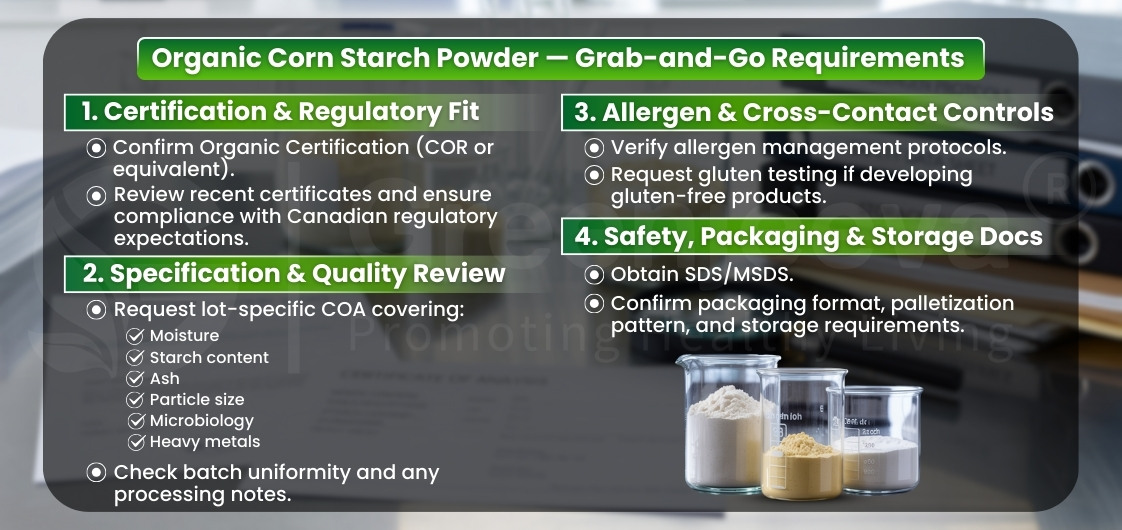
Canadian sourcing teams must evaluate compliance in parallel with performance. Standard documentation when working with Bulk Corn Starch Powder suppliers in Canada includes:
Essential documents
– Certificate of Analysis (COA)
Contains moisture, pH, ash, microbial counts, and particle size details.
– Organic Certification
USDA Organic or equivalent recognized standards for Canada.
– MSDS
For handling and safety requirements.
– Non-GMO statement
Since organic certification typically implies non-GMO.
– Allergen statement
To confirm the absence of major allergens.
– Heavy metals report
Verified against acceptable limits under Canadian standards.
– Pesticide residue testing
As applicable under organic guidelines.
What buyers should confirm with suppliers
– Batch traceability
– Country of origin
– Processing aids used (if any)
– Packaging materials and storage guidelines
For sampling, many Bulk Organic Corn Starch Powder suppliers provide:
– Evaluation samples
– Technical data sheets
– Specification sheets for pre-approval
MOQ varies from 20–25 kg bags to bulk pallet loads, depending on supplier capabilities.
What Are the Current Usage Trends and R&D Considerations in Canada?
Usage is rising across clean-label food systems, nutraceuticals, and personal care categories due to its versatility and consistent functional behavior.
Across Canada, brands continue incorporating Organic Corn Starch Powder for its predictable behavior and compatibility with clean-label claims.
Notable formulation trends
– Increased use in plant-based formulations
– Replacement of modified starches in sauces and snacks
– Growth in personal care emulsions and dry shampoo systems
– Wider use as a binder in nutraceutical manufacturing
– Demand in pet nutrition for structure and texture consistency
Supply chain considerations
Canadian buyers often evaluate:
– Lead time stability
– Shipment conditions during winter
– Availability of organic-certified lots
– Price fluctuations influenced by crop cycles
As wholesale corn starch powder price becomes more competitive, procurement teams emphasize functionality and traceability before selecting long-term supply partners.
Conclusion
Evaluating moisture, particle size, and functional behavior is essential when sourcing Bulk Organic Corn Starch Powder for industrial applications. These parameters influence performance across food systems, supplements, beverages, personal care items, and pet formulations. Canadian manufacturers benefit most when suppliers provide transparent documentation, consistent quality, and clarity around processing and compliance.
If your team is assessing Bulk Organic Corn Starch Powder suppliers, reach out to Green Jeeva for samples, compliance documents, and technical support tailored to your formulation and sourcing requirements. Get a quote now!
**The Food and Drug Administration has not evaluated these statements. This product is not intended to diagnose, treat, cure, or prevent any disease.**