
Magnesium is one of the most widely used minerals in dietary supplements and functional formulations. However, when sourcing for industrial use, buyers often face a technical question that affects labeling, compliance, and formulation behavior:
“Is magnesium bisglycinate the same as magnesium glycinate?”
For procurement managers, R&D teams, and contract manufacturers in Canada, this is not just a naming issue. The distinction can influence elemental magnesium content, chelation efficiency, compressibility, and how the ingredient appears on a product label.
This article breaks down the technical differences between magnesium bisglycinate powder and magnesium glycinate, and what sourcing teams should verify before bulk purchasing.
What Is Magnesium Bisglycinate Powder and How Is It Manufactured
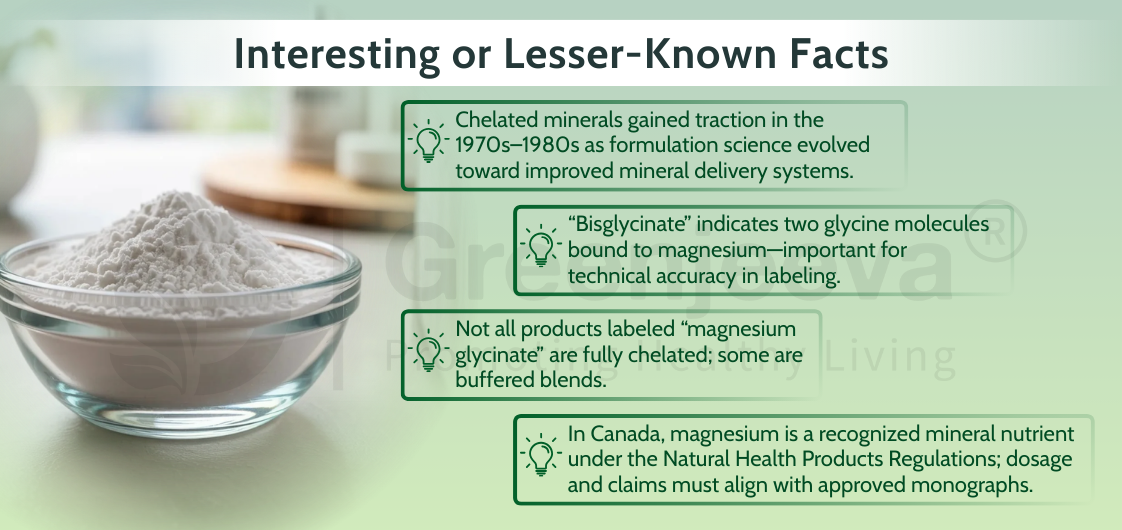
Magnesium bisglycinate powder is a fully chelated form of magnesium where one magnesium molecule is bound to two glycine molecules.
Magnesium bisglycinate powder is produced by reacting a purified magnesium source such as magnesium oxide or magnesium carbonate with glycine under controlled pH and temperature conditions. When the reaction is complete, a stable chelated complex is formed.
In a true bisglycinate structure:
-
• One magnesium ion is bound to two glycine molecules
-
• The structure is chemically defined
-
• Chelation percentage is measurable
After reaction:
-
• The material is dried (often spray dried)
-
• Milled to required mesh size
-
• Tested for elemental magnesium content
-
• Assayed for heavy metals and microbiological compliance
For formulation teams, the key factor is whether the ingredient is fully reacted or partially buffered with unreacted magnesium salts. Not all materials labeled as magnesium glycinate meet full chelation standards.
Is Magnesium Glycinate the Same as Magnesium Bisglycinate in Formulation
Not always. The terms are sometimes used interchangeably, but they are not technically identical in every case.
This is where confusion enters the sourcing process.
Magnesium Bisglycinate
-
• Refers specifically to a structure where magnesium is bound to two glycine molecules.
-
• Indicates a defined chelate complex.
-
• Often used in premium mineral formulations.
Magnesium Glycinate
-
• Can refer to bisglycinate.
-
• May also refer to a broader magnesium–glycine complex.
-
• In some cases, may include unreacted magnesium oxide or blends.
For formulators, the practical differences may include:
-
• Elemental magnesium percentage variation
-
• Flowability differences
-
• Compressibility in tablets
-
• Label declaration accuracy
-
• Assay consistency across batches
Because labeling regulations in Canada require accurate mineral declaration per serving, elemental magnesium verification through COA is essential.
In short, magnesium bisglycinate vs magnesium glycinate is primarily a question of chelation specificity and manufacturing integrity.
How Does Magnesium Bisglycinate Powder Behave in Tablets and Capsules
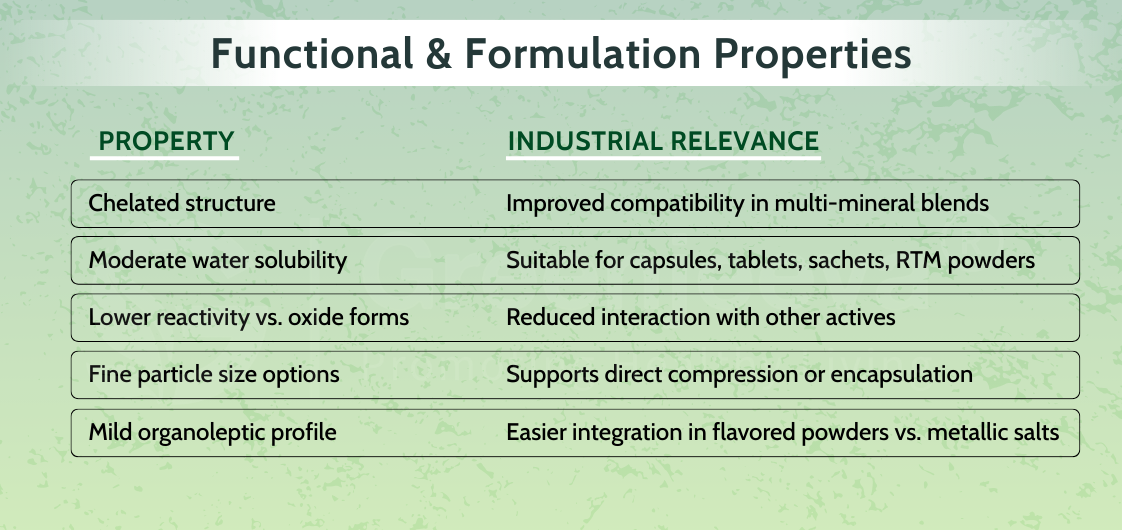
Magnesium bisglycinate powder typically offers better compatibility and milder reactivity compared to inorganic magnesium salts.
From a formulation standpoint:
Flow Characteristics
Magnesium bisglycinate powder generally has:
-
• Moderate bulk density
-
• Acceptable flow properties for encapsulation
-
• Lower dusting compared to some lighter magnesium salts
Compression Performance
In direct compression systems:
-
• May require binders depending on particle size
-
• Exhibits stable blending with excipients
-
• Shows reduced interaction with other minerals in multi-mineral blends
Capsule Integration
Commonly used in:
-
• HPMC capsules
-
• Hard gelatin capsules
-
• Mineral blend capsules
Because the chelated structure reduces ionic reactivity, formulators often observe improved compatibility when combining it with botanicals, vitamins, or amino acids.
What Should Buyers Verify When Comparing Magnesium Bisglycinate vs Magnesium Glycinate
Buyers should verify chelation status, elemental assay, heavy metals, and documentation before placing bulk Magnesium Bisglycinate Powder orders.
When evaluating a magnesium bisglycinate supplier in Canada, procurement teams should request:
-
1. Chelation Verification
-
• Is the material fully reacted?
-
• What percentage of chelation is confirmed?
-
• Is there documentation supporting the chelate structure?
-
2. Elemental Magnesium Assay
-
• Confirm percentage via ICP testing.
-
• Typical range varies depending on chelation efficiency.
-
3. Heavy Metal Testing
-
• Lead
-
• Arsenic
-
• Cadmium
-
• Mercury
Testing should align with Canadian regulatory requirements.
-
4. Microbial Profile
-
• Total plate count
-
• Yeast and mold
-
• Pathogen absence documentation
-
5. Allergen and GMO Statements
-
• Non-GMO confirmation
-
• Allergen-free declaration
-
• BSE/TSE statement
-
6. Regulatory Documentation
-
• COA
-
• MSDS/SDS
-
• Country of origin
-
• Stability data where available
For magnesium bisglycinate powder wholesale orders, consistency across batches is often more important than price per kilogram.
Can Magnesium Bisglycinate Powder Be Used in Functional Beverages and Sachets
Yes, but formulation testing is required for solubility and sedimentation control.
Magnesium bisglycinate powder is moderately soluble. In powdered beverage mixes and stick packs, it integrates well with:
-
• Electrolyte blends
-
• Amino acid powders
-
• Mineral combinations
However, in ready-to-drink formats:
-
• Sedimentation risk must be evaluated
-
• pH compatibility testing is required
-
• Stability trials are recommended
Mesh size and particle distribution directly affect dispersibility. For beverage manufacturers, requesting specific PSD (particle size distribution) data from a magnesium bisglycinate powder bulk supplier is critical.
What Should Canadian Buyers Know About Bulk Sourcing
Verify compliance readiness, supply continuity, and spec alignment before confirming large-volume orders.
Typical industrial purchasing details:
-
• MOQ often starts at 25 kg per drum
-
• Pallet quantities for contract manufacturers
-
• Supersacks for high-volume production
When sourcing magnesium bisglycinate powder wholesale, Canadian buyers should assess:
-
• North American warehousing availability
-
• Lead times
-
• Import classification
-
• Stability under Canadian storage conditions
-
• Lot traceability systems
Supplier transparency in testing methodology and documentation reduces future compliance friction.
Conclusion
Magnesium bisglycinate is often used interchangeably with magnesium glycinate, but they are not always identical in formulation terms. The difference typically lies in chelation integrity, elemental magnesium percentage, and manufacturing precision.
For R&D teams and sourcing managers, the question is less about naming and more about specification control. Fully chelated magnesium bisglycinate powder offers structural clarity, predictable assay values, and improved compatibility in multi-ingredient systems. However, only verified documentation can confirm this.
When comparing magnesium bisglycinate vs magnesium glycinate, always evaluate the chemical structure, assay, testing standards, and supplier transparency before scaling production.
Looking for a Reliable Magnesium Bisglycinate Powder Bulk Supplier
If your team is evaluating bulk magnesium bisglycinate powder for capsules, tablets, sachets, or functional blends, Green Jeeva provides:
-
• Local Stock, Same-Day Shipment
-
• Complete documentation
-
• Heavy metal and microbial testing reports
-
• Free Sample to evaluate first
-
• Zero-question-asked return policy
Register with Green Jeeva to review current specifications, COA, samples, and bulk availability details for magnesium bisglycinate powder.
**The Food and Drug Administration has not evaluated these statements. This product is not intended to diagnose, treat, cure, or prevent any disease.**