

For Canadian food manufacturers and private-label brands, cassava flour has become a widely used ingredient across gluten-free, plant-based, and clean-label formulations. However, sourcing organic cassava flour at commercial scale involves more than verifying origin or price.
From consistency and documentation to bulk performance and import readiness, procurement teams must evaluate cassava flour as a functional, compliance-sensitive ingredient not a commodity.
This guide outlines what Canadian buyers should assess before approving organic cassava flour for bulk procurement.
Why Cassava Flour Is Used in Commercial Food Formulations
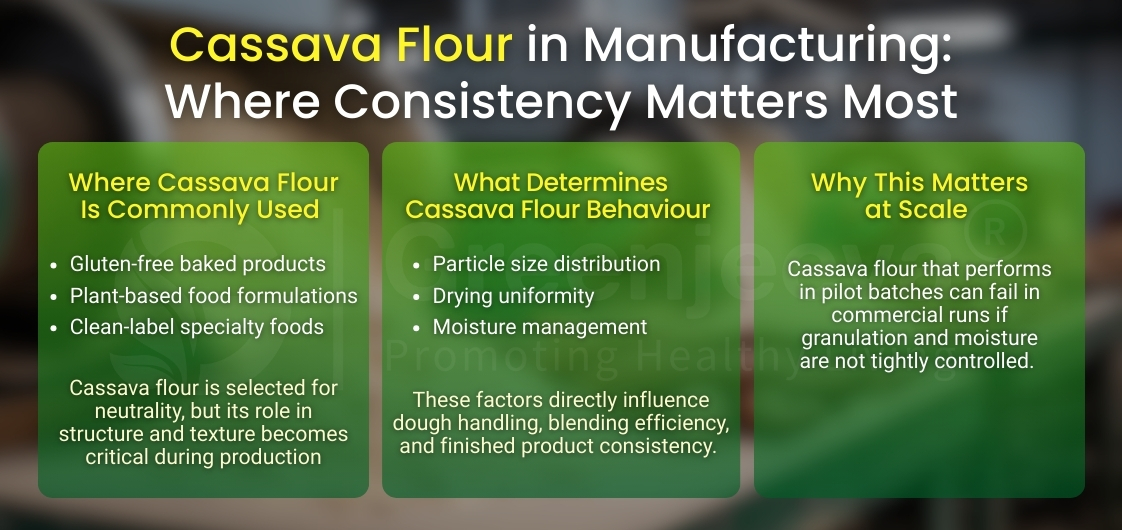
Cassava flour is valued for its neutral taste profile, versatility, and compatibility with a wide range of applications. As a cassava-based flour ingredient, it is commonly incorporated into:
- Gluten-free baked goods
- Plant-based product lines
- Clean-label flour blends
- Specialty food formulations
Unlike refined starches, cassava flour retains more of the root’s natural structure, making tapioca root flour and cassava flour distinct in formulation behaviour.
What Makes Organic Cassava Flour Different in Procurement
For Canadian buyers, organic status is not just a marketing claim it directly affects supplier approvals and documentation review.
When sourcing organic cassava flour, procurement teams typically look for:
- Verified organic certification
- Transparent sourcing practices
- Clean processing without synthetic aids
As a clean-label flour alternative, organic cassava flour is often selected to support short ingredient decks and regulatory alignment in finished products.
Bulk Sourcing Considerations for Cassava Flour
When evaluating bulk cassava flour, consistency becomes a primary concern.
At commercial volumes, cassava-derived powder performance can vary due to:
- Root maturity differences
- Drying and milling processes
- Granulation and particle size variation
This is especially relevant when sourcing Bulk Cassava Flour Powder, where small deviations between batches can affect blending, texture, and finished product uniformity.
For manufacturers relying on cassava flour in bulk, repeatability is often more critical than initial sensory characteristics.
Documentation and Compliance Expectations in Canada
Canadian procurement teams operate within a compliance-driven environment. Before approving organic cassava flour for ongoing use, buyers typically review:
- Organic certification validity
- Ingredient specifications
- Country-of-origin documentation
- Batch traceability
As a gluten-free flour ingredient for manufacturing, cassava flour must also meet internal QA standards related to cross-contamination risk and handling practices.
Common Challenges When Sourcing Cassava Flour at Scale
Several challenges tend to emerge when moving from trial orders to sustained bulk supply:
- Variability in flour texture between shipments
- Inconsistent documentation across batches
- Supply chain disruptions due to origin dependency
- Approval delays caused by incomplete specifications
These risks are magnified when cassava flour is used as a plant-based flour for food formulations that require tight control over texture and processing behaviour.
What Canadian Buyers Should Evaluate Before Final Supplier Approval
Before finalizing a supplier for organic cassava flour, procurement and QA teams typically evaluate:
- Batch-to-batch consistency
- Milling and granulation stability
- Documentation readiness for audits
- Reliability of bulk supply
For brands using cassava flour for commercial food use, these checks help prevent reformulation, re-approval cycles, and production delays.
Final Takeaway for Canadian Procurement Teams
Cassava flour may appear straightforward, but at scale, sourcing organic cassava flour requires disciplined evaluation.
For Canadian buyers, success depends on treating cassava flour as a functional ingredient with compliance requirements, not just a gluten-free substitute. Careful supplier assessment upfront helps ensure consistency, approval confidence, and long-term supply stability.