
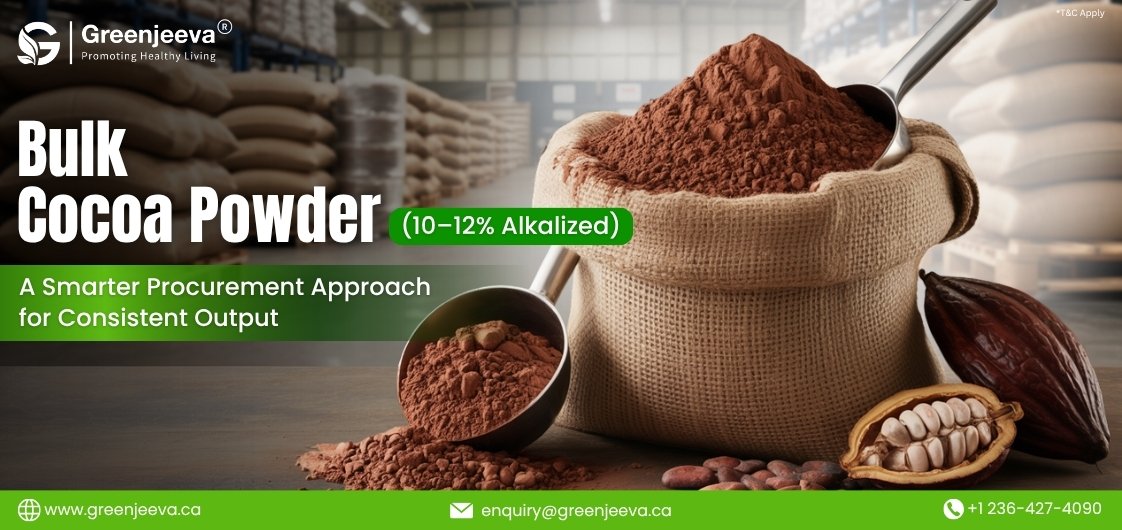
Bulk Organic Cocoa Powder 10–12% Alkalized: A Procurement Framework for Canadian Food Manufacturers
Procurement teams don’t usually worry about cocoa powder;until a batch behaves differently in production.
A slight shift in color, dispersion, or moisture can quietly impact product consistency, especially when you’re working at scale. And with bulk organic cocoa powder, 10–12% alkalized, those small variations don’t stay small for long.
For Canadian manufacturers, the challenge is more layered. Supply is largely import-driven, timelines can stretch, and compliance expectations are non-negotiable. On paper, organic cocoa powder 10–12% alkalized looks standardized. In reality, performance depends heavily on sourcing, processing control, and supplier reliability.
This guide breaks down a practical procurement framework—what to actually evaluate, what to question, and where most teams tend to miss the details.
Why 10–12% Alkalized Cocoa Powder Is Widely Used in Industrial Formulations
Most manufacturers aren’t choosing cocoa powder based on label claims—they’re choosing it based on how reliably it performs.
10–12% alkalized cocoa powder sits in a functional sweet spot for many applications. It offers a balanced fat content that supports process consistency without making the formulation overly rich or difficult to handle.
In bakery systems, it contributes to stable color and predictable mixing behavior. In beverages, alkalization improves dispersibility, reducing clumping during processing. In dairy and confectionery applications, it helps maintain uniform flavor and appearance across batches.
Alkalization itself plays a key role. By treating cocoa with an alkaline solution (often referred to as Dutching), manufacturers can control pH, which directly affects color, solubility, and overall stability. A well-controlled alkalization process results in a smoother, darker powder that integrates more easily into industrial formulations.
That’s why organic cocoa powder 10–12% alkalized continues to be a preferred format across multiple product categories—it’s not just about composition; it’s about consistency under real manufacturing conditions.
Why Bulk Cocoa Powder Isn’t as Standardized as It Seems
At first glance, bulk alkalized cocoa powder looks like a commodity ingredient. The specifications appear similar across suppliers, and documentation often checks the required boxes.
But the variability starts earlier in the supply chain.
Cocoa beans sourced from different regions—West Africa, Southeast Asia, or Latin America—can vary in inherent characteristics. These differences carry forward into the final powder, even after processing.
Then comes alkalization. Not all Dutching processes are identical. Variations in pH control, processing time, and equipment can lead to noticeable differences in color intensity, solubility, and dispersion behavior.
Batch-to-batch consistency is where most issues surface. A sample may perform perfectly during approval, but subsequent shipments may show subtle deviations—slightly darker color, slower dispersion, or changes in moisture.
For manufacturers working with cocoa powder bulk quantities, these inconsistencies don’t just affect product quality—they disrupt production predictability.

A Practical Procurement Framework for Bulk 10–12% Alkalized Cocoa Powder
1. Raw Material Sourcing & Traceability
Start upstream.
A reliable bulk cocoa powder supplier in Canada should be able to clearly communicate sourcing origins and supply chain structure. Traceability is not just about documentation—it’s about understanding how consistent the raw material pipeline is.
Ask direct questions:
- Is the origin consistent across batches?
- Is there a defined sourcing region or multiple sourcing points?
- How is traceability maintained from bean to powder?
Clarity here reduces surprises later.
2. Standardization & Batch Consistency
This is where procurement decisions often need more rigor.
Request COAs for at least the last three batches—not just the sample. Look for consistency in:
- Fat content (10–12% range)
- Moisture levels
- Color parameters (if available)
Even small variations can impact production outcomes. With 10-12% alkalized cocoa powder, consistency across batches matters more than hitting a single spec once.
3. Processing Parameters (Alkalization Control)
Alkalization defines performance.
A supplier should be able to indicate the pH range and how tightly it is controlled. Even slight deviations in pH can influence the following:
- Color uniformity
- Dispersibility
- Interaction with other ingredients in formulation
When evaluating cocoa powder 10–12% alkalized, don’t just confirm that it is alkalized—understand how consistently that process is managed.
4. Physical & Functional Properties That Affect Manufacturing
Beyond chemical specs, physical properties often determine how smoothly production runs.
Key factors to review:
- Flowability (affects handling and dosing)
- Dispersibility (critical for beverage and liquid systems)
- Bulk density (impacts packaging and formulation calculations)
For bulk alkalized cocoa powder, these properties directly influence efficiency on the production floor.
5. Compliance & Certifications (Canada-Focused)
Compliance is non-negotiable.
For cocoa powder wholesale sourcing in Canada, ensure alignment with:
- CFIA requirements
- Microbiological standards
- Heavy metal limits
- Allergen declarations
Depending on your product category, certifications such as organic, non-GMO, or kosher may also be relevant. What matters is not just availability, but consistency of documentation across shipments.
6. Packaging, Logistics & Shelf Stability
Logistics can quietly affect ingredient performance.
Bulk cocoa powder is sensitive to moisture and environmental conditions. Packaging formats should be designed to maintain stability during transit and storage.
Evaluate:
- Packaging type (multi-layer bags, liners, etc.)
- Storage recommendations
- Typical lead times and dispatch capabilities
For Canadian manufacturers, local warehousing or faster distribution channels can significantly reduce supply risk.
Red Flags to Watch When Evaluating a 10–12% Alkalized Cocoa Powder Supplier
Some risks don’t show up in the first interaction.
Watch for:
- Inconsistent or incomplete COA history
- Limited transparency on origin
- No clarity on alkalization process
- Overemphasis on price without performance discussion
A reliable 10-12% alkalized cocoa powder supplier should be able to support technical conversations—not just commercial ones. If details feel vague early on, they usually become bigger issues later.
How Canadian Manufacturers Are Rethinking Cocoa Powder Procurement
Procurement strategies are shifting.
More teams are moving away from short-term price optimization toward long-term supply reliability. The focus is gradually shifting to:
- Stable supplier relationships
- Predictable batch performance
- Strong documentation and traceability
Working with a dependable bulk cocoa powder supplier in Canada is no longer just about availability—it’s about reducing variability across the entire production cycle.

Conclusion
Cocoa powder may look like a standardized ingredient, but procurement decisions have a direct impact on product consistency and production efficiency.
For bulk cocoa powder, especially 10–12% alkalized cocoa powder, the focus should go beyond specifications. Supplier transparency, batch reliability, and process control play a much larger role in long-term performance.
Taking a structured approach to evaluation helps reduce variability and ensures that what works in the sample stage continues to work at scale.