What Manufacturers Need to Know About Turmeric Bioavailability
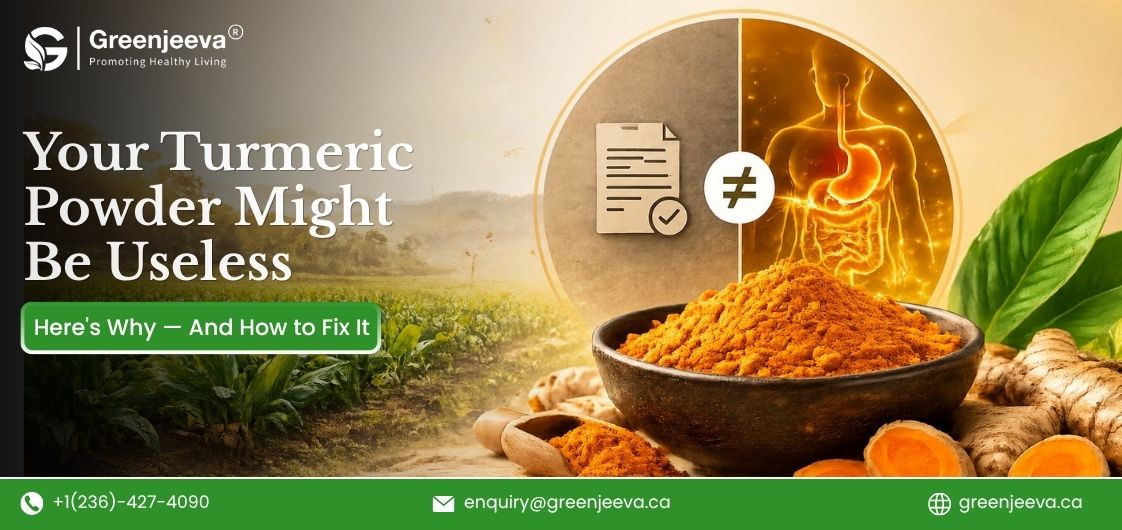
Curcumin content is only part of the story. Here's what sourcing teams and product formulators should understand before finalizing their turmeric ingredient strategy.
Curcumin Percentage Doesn't Tell the Whole Story
You've sourced a quality turmeric powder. The COA looks strong. Curcumin content checks out. Whether you're working with organic turmeric root powder, a concentrated organic curcumin powder, or standard bulk turmeric powder, the ingredient appears to meet spec.
What the COA doesn't show is how much of that curcumin actually reaches systemic circulation after a consumer takes your product.
Curcumin has well-documented bioavailability challenges that apply regardless of the raw material form—turmeric root powder, turmeric curcumin powder, organic turmeric powder, or even a 95%-standardized extract. Curcumin percentage measures what's in the ingredient. It doesn't measure what the body can use.
For manufacturers, this is a formulation consideration worth addressing at the product development stage rather than after launch.
Why Curcumin Absorption Is a Formulation Challenge
Curcumin—the primary active compound in turmeric (Curcuma longa)—faces three characteristics that limit its absorption when taken orally in unformulated form.
It is poorly soluble in water, which makes crossing the aqueous gut environment difficult. It undergoes rapid metabolic conversion in the intestinal wall and liver, producing metabolites with different activity profiles. And what does reach circulation is cleared quickly, with a short plasma half-life.
The practical result: intact curcumin levels in the bloodstream following standard oral consumption are consistently low in published research — well below concentrations used in laboratory settings to study the compound's properties. This gap between raw curcumin content and actual bioavailability is why formulation approach matters as much as ingredient selection.
Understanding the Different Forms of Turmeric Powder
Not all turmeric powder is the same. Here's a clear breakdown of the main commercial forms and what each is suited for.
Turmeric root powder is dried, ground turmeric rhizome—the base form used in food applications, spice blends, and entry-level supplements. It typically contains 2–5% curcumin by weight. It's the most widely available and cost-effective form, appropriate where color and flavor are the primary application goals.
Organic turmeric powder / organic turmeric root powder follows the same processing as conventional turmeric root powder but is produced under certified organic farming conditions — no synthetic pesticides or fertilizers. Organic turmeric root powder carries a premium and has strong appeal in natural-products markets. Organic certification speaks to agricultural practice, not bioavailability—absorption characteristics are the same as conventional turmeric powder.
Organic curcumin powder is a concentrated extract, typically standardized to 95% curcuminoids. It provides a much higher active compound per gram than whole-root powder. However, a higher curcumin percentage does not automatically translate to better absorption—a lower-dose, well-formulated delivery system may offer more practical bioavailability than a high-percentage extract with no delivery enhancement.
"Turmeric Curcumin Powder" is a term used broadly by suppliers to describe curcuminoid-standardized extracts intended for both food and supplement use. When evaluating this category from any turmeric powder supplier, ask specifically whether human bioavailability data exists—not just in vitro results.
Black turmeric powder comes from Curcuma caesia, a distinct species with a different phytochemical profile from standard golden turmeric. It remains a specialty ingredient with limited commercial adoption and a thinner research base. It may suit brands seeking differentiation, but consistent large-scale sourcing of quality black turmeric powder is more complex than sourcing standard bulk turmeric powder.
Fermented turmeric powder is produced through a controlled fermentation process that partially breaks down the plant cell wall, potentially improving compound accessibility. It is an emerging category with a compelling positioning for gut-health-oriented brands. The evidence base is still developing — it should be considered a differentiated ingredient rather than a direct substitute for clinically validated bioavailability technologies.
"Bulk turmeric powder" refers to turmeric purchased at manufacturing volumes, typically 25kg and above. The key variables at this scale are curcumin content consistency across harvests, heavy metals testing, microbial results, country of origin transparency, and supplier certifications.
Bioavailability Enhancement Options
Manufacturers who want curcumin to perform beyond culinary or color applications have several formulation options. Each has a different mechanism, cost, and evidence base.
Piperine (Black Pepper Extract) is the most widely used approach. Piperine inhibits the metabolic enzymes that break curcumin down before absorption, extending its presence in circulation. A study published in Planta Medica reported approximately 20-fold higher curcumin blood concentrations when 20 mg of piperine was co-administered with 2,000 mg of curcumin, depending on study design. The ratio matters — this effect is tied to the specific dose relationship used in the research. One formulation consideration: piperine inhibits liver enzymes involved in metabolizing several common pharmaceutical drugs. This may be relevant for products targeting populations managing multiple medications.
Phytosome technology bonds curcumin to phospholipids, creating a lipid-compatible complex that the gut wall handles more efficiently. Meriva (Indena) is the most clinically studied phytosome curcumin available and has multiple published human trials behind it, with absorption improvements reported at approximately 29-fold versus standard extract in published studies, depending on the formulation. This approach carries a lower drug-interaction risk profile than piperine and is well-suited to premium supplement lines.
Liposomal and nanoparticle formats encapsulate or reduce curcumin to improve solubility and gut-wall crossing. Liposomal curcumin is particularly effective in liquid formats. Nanoparticle dispersions (e.g. Theracurmin) have shown meaningful absorption improvements in human pharmacokinetic studies. Both approaches involve higher manufacturing cost and, for nanoparticle formats, increased regulatory complexity in some markets.

A practical note across all formats: curcumin absorbs better alongside dietary fat. Traditional Indian cooking has always paired turmeric with ghee or oil for this reason. If your delivery vehicle already contains fat—a nut-containing bar, a full-fat dairy application, an oil-based format—this co-ingestion benefit may already be present.
Labeling: The Key Distinction to Know
The most important regulatory line for curcumin products in the US is the difference between structure/function claims and disease claims.
Structure/function claims describe how an ingredient supports normal body function and are the standard approach for supplements. They require manufacturer substantiation and the FDA disclaimer. Disease claims — stating or implying that a product treats or prevents a specific condition — require FDA drug approval that no turmeric product holds.
Language like "enhanced absorption formula," "superior bioavailability vs. standard turmeric powder," or "formulated for improved curcumin absorption" represents factual product characteristics you can support with data. Language implying treatment of named conditions does not. The FDA evaluates total marketing context — website, social media, and testimonials — not just label copy. Consult regulatory counsel before finalizing any claims.
Sourcing Considerations: What to Verify Beyond Curcumin Percentage
This is where procurement decisions get made or come apart. For any turmeric powder supplier — whether supplying standard bulk turmeric powder, organic turmeric root powder, fermented turmeric powder, or organic curcumin powder — these are the areas worth verifying directly.
Origin and Consistency Curcumin content in turmeric varies by growing region, harvest season, and post-harvest handling. India accounts for the majority of global turmeric supply, but curcumin percentages differ between regions like Alleppey and Erode and between crop years. Ask your supplier for curcumin content ranges across recent batches, not just a single COA figure. Batch-to-batch consistency is a real sourcing variable.
Heavy Metals and Adulteration: Lead contamination has been a documented problem in some turmeric supply chains—in several cases linked to lead chromate, a yellow compound sometimes used to enhance color in post-harvest processing. This is a food safety and brand liability risk. Any credible turmeric powder supplier should be able to provide recent third-party heavy metals test results covering lead, cadmium, arsenic, and mercury. If a supplier can't produce these, that's a meaningful red flag.
Adulteration — the addition of other yellow substances to increase apparent curcumin content — is also a known issue in lower-cost supply chains. Request HPLC-based curcuminoid testing, not colorimetric methods alone, which are easier to manipulate.
Certifications and Traceability: For food safety, look for SQF, BRC, or ISO 22000 certification from the supplier. For organic claims, verify current certification status from a recognized body (USDA Organic, EU Organic, or equivalent) — not a historical certificate. Ask whether the supplier can trace the ingredient to its farm or region of origin.
For Extract Products: Bioavailability Documentation If you're sourcing a turmeric curcumin powder or organic curcumin powder positioned for supplement use, ask directly whether human pharmacokinetic data exists—AUC and Cmax figures from published or proprietary studies, not in vitro results only. If a supplier's bioavailability claims rest only on in vitro data, that's worth noting in your evaluation.
Questions worth putting to any turmeric powder supplier:
- What is the curcumin content range across the last four to six batches?
- What third-party heavy metals testing do you conduct, and how often?
- Do you test for adulteration, and with what method?
- What food safety certifications are current?
- Can you provide supply chain traceability to origin?
- For extracted products: Is there published human bioavailability data for this specific formulation?
Procurement Takeaway
Turmeric powder — in its various forms, from standard turmeric root powder to organic curcumin powder to fermented turmeric powder — is a well-established ingredient with broad application across food, beverage, and supplement categories.
The bioavailability consideration is real, but it's manageable. The key is treating it as a formulation decision rather than ignoring it at the sourcing stage. Curcumin percentage alone should not be the primary driver of purchasing decisions—consistency, testing documentation, supply chain transparency, and formulation support from a supplier are equally important criteria.
Procurement teams that ask the right questions and select suppliers who can answer them with documentation are in a stronger position than those evaluating turmeric purely on price per kilogram and curcumin percentage.
Explore More Organic Superfood Ingredients from Green Jeeva Canada
Along with organic spirulina powder, Green Jeeva Canada offers a broad portfolio of premium organic superfood, botanical, and functional ingredients for food, beverage, nutraceutical, and wellness applications. Our ingredients are carefully sourced to support clean-label product development and innovative formulations.
Explore some of our related organic ingredients:
- Shilajit Extract Powder 40% Fulvic Acid
- Organic Camu Camu Fruit Powder
This article is for educational purposes for food and supplement industry professionals. It does not constitute legal or regulatory advice. Consult qualified regulatory counsel before finalizing label claims.